Wednesday, March 22, 2006

Darth Benedict: "Turn to the Anti-Gay Side"

From Gerald Augustinus (The Cafeteria is Closed): The National Catholic Reporter has an editorial online about the ban on gay adoptions by Catholic Charities of Boston and the general "boosting" of "the anti-gay troops." I don't really want to discuss the gay adoption ban since it's been discussed endlessly already. Actually, I'd rather discuss NCR's subtle demonization of Pope Benedict XVI:

There is much in the Catholic air these days about homosexuality. Pope Benedict XVI, as then-Cardinal Joseph Ratzinger, has provided much of the content, from the assertion that gays are "objectively disordered" to the 2003 document issued by the Congregation for the Doctrine of the Faith, which Ratzinger then headed, that called gay parenting "gravely immoral" and said permitting gay couples to adopt "would actually mean doing violence to these children."

He has certainly emboldened the troops . . .


It's not that there's anything untrue about what NCR has written in the above quote. What's remarkable is how they place all of the blame for the Church's teaching on homosexuality squarely on the shoulders of Pope Benedict XVI, even before he was elected to the Chair of St. Peter. The determinations of the Congregation for the Doctrine of the Faith under his prefecture were his fault, even though the media usually blames the reigning pope or "the Vatican" in general for curial decisions. Look, for example, at the ban on gay seminarians issued recently by the Congregation for Catholic Education. Did you see even one media report single out Cardinal Zenon Grocholewski (who?), the prefect of the Congregation for Catholic Education? No. Instead, the media focused on "the Vatican" ban, and many blamed Pope Benedict XVI directly for the ban, even though it was Cardinal Grocholewski's signature on the document just as it was Cardinal Ratzinger's signature on the documents of the Congregation for the Doctrine of the Faith. So why has Pope Benedict XVI always had to bear the blame for the Church's teaching on homosexuality, even when he worked under his predecessor?

I think there are basically two reasons for this.

The first reason is denial. I know a lot about this one, because I have been guilty of demonizing Pope Benedict XVI because I was living in denial. Many people, even those who vehemently disagreed with him, liked and even loved Pope John Paul the Great. They do not want to hate him for teachings they cannot accept, so they live in denial pretending that such teachings were not his own. Instead, these teachings must come from a nefarious anti-John Paul II, and in Cardinal Ratzinger they had found just such a caricature. Cardinal Ratzinger was blamed for all manner of controversial Church teachings during Pope John Paul the Great's pontificate, but he was especially blamed for that pontificate's teachings on homosexuality. Even after the death of Pope John Paul the Great, this living in denial has continued for many. Refusing to accept that most of the world's bishops and clergy agree with the Church's teaching on homosexuality, or at least with most of it, Pope Benedict XVI is solely blamed for that teaching and subsequently ignored as a homophobic bigot.
The second reason is convenience, and I think this may be the reason that applies to NCR. It is inconvenient for the media to blame and demonize Pope John Paul the Great for the Church's teaching on homosexuality. How might the millions of faithful who stood in St. Peter's Square and chanted "Santo Subito!" -- "Saint Now!" react to a demonization of their late, charismatic, beloved pope? In many ways, Pope Benedict XVI has always been a victim of Pope John Paul the Great's charisma. Because the media is too afraid of the backlash that would result from attacking Pope John Paul the Great, they have always chosen instead to attack the man who is now Pope Benedict XVI. Pope Benedict XVI is quiet, he is introverted, he is scholarly. In short, he does not have the cult of personality that accompanied Pope John Paul the Great. Thus, the media (including much of the Catholic media) has always attacked him for teachings which rightly belonged to his predecessor, and they still continue to do so.

For example, Pope Benedict XVI was named anti-gay person of the year by the Washington Blade for teachings which were really his predecessor's, and no one even batted an eyelash. The Washington Blade would never have had the intestinal fortitude to name Pope John Paul the Great its anti-gay person of the year, not while he was alive and certainly not now that he has fallen asleep in the Lord. So they attack and demonize his successor because it is convenient for them.

It's time for everyone -- those who support the Church's teaching on homosexuality and those who oppose it -- to start telling the truth. The demonization of Pope Benedict XVI for the Church's teaching on homosexuality must stop. Yes, it is true that Pope Benedict XVI authored several documents clarifying the Church's teaching on homosexuality as prefect of the Congregation for the Doctrine of the Faith. But it is equally true that not one jot or tittle comes forth in an official document from the Congregation for the Doctrine of the Faith or any other curial dicastery without the approval of the reigning pope: in other words, Pope John Paul the Great. It is also true that most documents which are published by curial dicasteries were actually commissioned by the pope, so that it was probably Pope John Paul the Great who requested that the Congregation for the Doctrine of the Faith clarify the Church's teaching on homosexuality. It is unlikely that the current pope would have taken his own initiative as the prefect of that dicastery. Pope John Paul the Great was directly responsible for the Church's teaching on same-sex marriage and gay adoption.

What about more recent developments? Notable among these developments is the ban on gay seminarians published by the Congregation for Catholic Education. It is true that Pope Benedict XVI bears some responsibility for this ban, since he was the pope who approved it. But it is also true that it was Pope John Paul the Great who commissioned the document quite some time before he passed away, so that responsibility for the ban is shared between the current pontificate and the previous one -- it is not all Pope Benedict XVI's fault, as so many have either stated or implied. And let us not forget that the ban on gay seminarians and priests predated even the new document by the Congregation for Catholic Education, since a document published in the 1960s had already banned the ordination of gay men but was subsequently ignored.

Although Pope Benedict XVI is his own pope with his own pontificate, it is also true that he has done nothing new in regard to homosexuality. His opposition to same-sex marriage in Spain, his opposition to gay adoption throughout the world: these are not really new developments, but only continuations of what Pope John Paul the Great was already teaching. And indeed, these new teachings to address modern situations are only continuations of what the Church has always taught in regard to homosexuality, so that even Pope John Paul the Great cannot be blamed and demonized for them. When we blame and demonize Pope Benedict XVI and Pope John Paul the Great for the Church's teaching on homosexuality, we do the same to all of the popes before them, to the Church Fathers and to many saints, to St. Paul who began the Church's teaching on homosexuality, and to the prophets of the Old Covenant who preceded St. Paul.

Am I saying that Pope Benedict XVI bears no responsibility for the Church's teaching on homosexuality, either as prefect of the Congregation for the Doctrine of the Faith or as pope? Of course not; that would be to deprive him of his own teaching authority. My point is simply that it is dishonest and wrong to blame him for his predecessor's teaching on homosexuality, which was itself a continuation of what the Church has always taught in regard to homosexuality. Pope Benedict XVI is not some kind of anti-gay demon; he is a man, who is also the pope, who is continuing to teach what the Church has taught before him -- whether we like it or whether we don't.

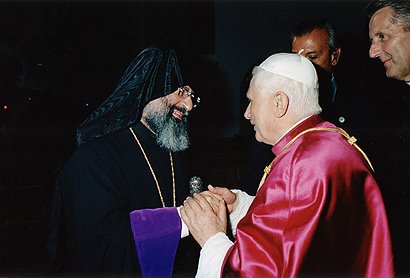
Patriarch of the West, Redux


From Domenico Bettinelli: The Pontifical Council for Promoting Christian Unity has explained the pope's reasoning behind dropping the papal title "Patriarch of the West" -- although, I must confess, I don't think I understand any better after reading the explanation than I did before reading it. If anyone does get it, feel free to clue me in.

Altar Girls and Priestly Vocations

Many of you have probably already heard that the Diocese of Arlington has authorized two indult Tridentine Masses to be celebrated in different regional locations within the diocese, and that the bishop has also authorized young women to serve at the altar along with young men if the pastor believes that such is pastorally wise after consulting his parishioners. This is a first in the Arlington diocese's history.

There are some Catholics who believe that we should not have altar girls. Although I do not count myself in their company, I wonder if Catholics who support female altar service have ever bothered to consider the argument offered by those who oppose female altar service, or if they are even aware that there is an intelligent argument. Most seem to assume that opposition to female altar service arises out of sexism, either: a) the belief that the presence of women in the sanctuary profanes it; or b) the belief that young women serving at the altar can lead young men to feel insecure in their masculinity. Maybe there are Catholics who believe this way, but when I've talked to most Catholics who oppose female altar service, they oppose it for totally different reasons than the ones I've mentioned.

Most Catholics who oppose female altar service feel the way they do because they believe that altar service is connected to the priesthood, and that allowing young women to serve at the altar obscures this connection to the priesthood and leads to universal confusion. Whereas young men would once have looked on their altar service and seen a connection to the priesthood which might have led them to discern a vocation to the priesthood, opponents of female altar service believe that young women serving at the altar leads young men to lose sight of this connection to the priesthood and thus to lose a path to discernment for the priesthood. Opponents of female altar service also believe that allowing young women to serve at the altar can be confusing for them, insofar as it might lead them to feel that they have a vocation to the priesthood when the Church teaches that such a vocation is impossible. In short, opponents of female altar service generally oppose it because they feel that it confuses both the young men and the young women who serve at the altar, and the rest of the faithful along with them.

It is interesting to note that many who advocate for the ordination of women to the priesthood and for an end to mandatory celibacy for priests often claim to do so in the name of the vocation shortage. There are too few priests, they say, so perhaps we should begin opening the priesthood to married men and to women who feel called to serve Christ and the Church in priestly ministry. If we accept that this issue is similar to other controversial issues in which some are expressing legitimate concerns and others are only using the crisis at hand to support their own preconceived agendas, we can accept that it is likely that some are legitimately concerned about the vocation shortage and that some are only using the vocation shortage to bolster their agenda. In any event, I'd like to know what Catholics concerned about the vocation shortage think about what Catholics opposed to female altar service are saying. Since there is a vocation shortage, is it pastorally prudent to open altar service to young women when this might lead to fewer young men discerning a vocation to the priesthood? And is there really any connection between allowing female altar service and the decline in priestly vocations?

Mind you, I do not oppose female altar service. I just thought this would be an interesting issue to discuss.

Tuesday, March 21, 2006

Reforming the Reform

From Gerald Augustinus (The Cafeteria is Closed): Apparently, the apostolic exhortation that Pope Benedict XVI will publish in response to the most recent meeting of the Synod of Bishops, tentatively scheduled for release in October, will deal with a "reform of the reform" in regard to liturgical norms. The exhortation will apparently encourage greater use of Latin in the liturgy (but not in the Liturgy of the Word), greater use of Gregorian Chant and classical polyphony, elimination of secular music or lyrics, and elimination of instruments which are "inadequate for liturgical use." The apostolic exhortation is also expected to call for the exclusion of dance and applause in the liturgy, which makes sense to me -- we're not going to see a show.

One area in which I've remained consistently conservative is the area of the liturgy. Although I don't favor a complete return to Latin, especially not a sudden return, I recognize that Latin is the official language of the Roman Church and that it was the liturgical language of the Roman Rite for centuries prior to its replacement by the vernacular following the Second Vatican Council. Catholics should know Latin, and we should celebrate the liturgy together in Latin as a sign of our unity in our catholicity. I also believe that Gregorian Chant and polyphony hold a pride of place among liturgical music forms in the Roman Rite, and that these should be used more widely and should largely replace the ultrasaccharine folk music so common in the United States (especially music with questionable lyrics, like "Ashes").

One reservation I have is that I hope provisions will be made for cultures which are radically different from the European culture and its offspring, the North American and Latin American cultures. I'm thinking primarily of African Catholics and Asian Catholics. Some talk has been circulating that the African and Asian Churches should be given autonomous status similar to that of a patriarchate and freedom to develop their own liturgical norms. Until that discussion can be translated into action, perhaps Rome should at least allow the African and Asian bishops some freedom to inculturate the liturgy in their regions.

With that said, I don't think that this same freedom of inculturation should be extended to North America, and probably not to Latin America either, since our cultures are not so radically different from European culture that inculturation of the liturgy would be justified. Liturgical dance in America, for instance, has nothing to do with our culture, since we have never (until now) danced around in tutus and tights to worship God. But liturgical dance in Africa is quite different -- dance is deeply embedded in African culture as part of divine worship. Some provision should be made for authentic cultural expression, so that both the unity and the catholicity of the liturgy is preserved. While we're at it, though, let us not forget the holiness and the apostolicity of the liturgy; these have, to some degree, been abandoned in the postconciliar reform.

Another Prayer Request

This time from Susan Rose Francois at Musings of a Discerning Woman:

Back to a serious blog post, but this is important. I went to the hospital this evening to visit a friend from church and her daughter Gigi. Gigi is 4, almost 5 year old, and is in the pediatric ICU with encephalitis, an inflammation of the brain.

When I taught the Sunday pre-school Gigi was always one of my favorites. She is bright, inquisitive, a little willful and has wonderful fashion sense. She always had accessories that matched her dress! It was heartbreaking to see her in the hospital bed with tubes and wires and the ventilator coming out of her.

Please keep little Gigi and her mom, dad and little brother in your prayers.

Catholic Carnival LXXI

Catholic Carnival LXXI (that's 71) is up at A Song Not Scored For Breathing. My post on the labor riots in France and labor rights in general is featured.

Monday, March 20, 2006

Prayer Request

Christopher Blosser (Against the Grain) reports that Stephen Hand, the editor of TCRNews, has received tragic news about his son:

Today my family and I were given heartbreaking news, that my son's cerebral cortex, which controls cognition / thinking, has been damaged beyond human hope due to having been deprived of oxygen "for apparently a long time" sometime between Sat 12:30 AM and 1 PM (an 11.5 hr window). This means, we were told, the "thinking part" of his brain is "gone forever," barring a miracle, and that within 48 hours we should make a decision to take him off artificial life support "and give him peace". We asked for a second opinion and received the same answer, breaking our hearts altogether.


The situation is made even worse by a complex end of life decision, and Stephen appeals to priests and theologians for help in deciding what to do:

Apparently this morning, at the same time, they began feeding my son liquid nutrition / food through a nasal tuble. When I asked the doctors whether he would die from just the removing him from artificial life support, they told us not necessarily. He would, they said, because of his youth, more likely die first of dehydration and lack of nutrition. This means starvation and filled me with anxiety. We need help here to be morally certain in making a family decision. Is this removing of a nasal tube identical to the situation Terri Schiavo was in? Would this mean "actively killing" my son? Please, if you can find it in your heart to send me a brief, preferably official document, clarifying this for us, I / we would be most grateful. I am very reluctant to remove nourishment for the very same reasons the Schiavo's were. Am I missing something here? Is there some factor which makes the cases different in any essential way? Under what terms, if any, is it allowable, according to the Church, to remove nutritional support once it has been introduced?

Please pray that God's will is done, and for my family. The agony of watching a beloved son in what is being called an irreversible coma, is almost too much to bear. So we cling to the cross. Help us, if you can, to know what His will is in Heaven in regard to all this. Perhaps I should know all this myself, but I feel shamefully in deep confusion. Thank you. Send your replies to TCRnews2.com@gmail.com and thank you in advance for understanding that I may not be able to reply immediately. ---Stephen Hand


Eternal rest grant unto their son, O Lord, and let perpetual light shine upon him. May the souls of the faithful departed, through the mercy of God, rest in peace.

Our Lady of Sorrows, pray for them.
St. Joseph, pray for them.
Terri Schiavo, pray for them.

If Eight Priests Were Laicized...

...and the mainstream media only counts seven, were there really eight priests laicized?

Tuesday, February 28, 2006

Priests, Love Your Faithful...

From Damien's Spot: According to Catholic News Service, Cardinal William Levada, the prefect of the Congregation for the Doctrine of the Faith, used a recent homily for the installation of a new rector at the Pontifical North American College to take up his predecessor's favorite pastime: gay-bashing. Not only did Cardinal Levada say that the new instruction against the ordination of gay seminarians is relevant to the U.S. sexual abuse crisis, implying that gay priests bear the primary responsibility for that scandal -- he also misused the scriptural and traditional imagery of Christ and the Church as Bridegroom and Bride to assault the priestly ministry of existing gay priests:

The doctrinal chief said he wanted to look specifically at "the situation of the gay priest who announces his homosexuality publicly, a few examples of which we have recently heard reported" in reaction to the Vatican document.

"I think we must ask, 'Does such a priest recognize how this act places an obstacle to his ability to represent Christ the bridegroom to his bride, the people of God? Does he not see how his declaration places him at odds with the spousal character of love as revealed by God and imaged in humanity?'" he said.


The spousal imagery of Christ and the Church is a favorite theme of Vatican discrimination; the Vatican has been using the same spousal imagery since at least the publication of Inter Insigniores in 1976 by the Congregation for the Doctrine of the Faith, explaining in part that women could not be ordained to the priesthood because they cannot, so the Congregation said, properly image Christ as Head of the Church. Thus the Congregation for the Doctrine of the Faith established in 1976 that priests must be men like Christ. Apparently, the Congregation for the Doctrine of the Faith would now like to establish that priests must be heterosexual men like Christ -- although, mind you, there is no evidence that Christ actually was heterosexual (or homosexual), unless you believe Dan Brown.

And I wonder how far this ontological similarity is going to be carried? Perhaps soon we will have to begin forcing Jews to convert to Christianity again, since Christ was a Jew. Does that mean that all priests must be Jewish Christians in order to image Christ properly? Are all sacraments invalid if presided over by Gentile priests? For that matter, are all sacraments invalid if presided over by gay priests? If the Congregation for the Doctrine of the Faith establishes that gay men cannot properly image Christ and thus cannot receive the sacrament of holy orders -- and that's the direction it's headed in, from the way Cardinal Levada is talking -- that means that gay men were never able to properly image Christ, that they never validly received holy orders, and that all sacraments presided over by gay priests would have been invalid. That's quite a pickle! Maybe we should bring back Limbo after all. Do you know how many baptisms, confirmations, eucharists, reconciliations, anointings, marriages, and ordinations would be invalid now? There would be Catholics walking around who may never have received a valid sacrament, dead Catholics who were never baptized, never had Last Rites. It would be the biggest sacramental crisis in the history of the Church.

Of course, there is no crisis if you're still a Catholic who repudiates the Donatist heresy. That heresy was condemned by St. Augustine and several popes. But it seems that Donatism is once again on the rise.

There is a scriptural basis for the spousal imagery of Christ's relationship to the Church; it's found in Ephesians 5:21-33, building upon what Christ had already taught about his spousal relationship to the People of God:

Be subordinate to one another out of reverence for Christ. Wives should be subordinate to their husbands as to the Lord. For the husband is head of his wife just as Christ is head of the church, he himself the savior of the body. As the church is subordinate to Christ, so wives should be subordinate to their husbands in everything.

Husbands, love your wives, even as Christ loved the church and handed himself over for her to sanctify her, cleansing her by the bath of water with the word, that he might present to himself the church in splendor, without spot or wrinkle or any such thing, that she might be holy and without blemish. So also husbands should love their wives as their own bodies. He who loves his wife loves himself. For no one hates his own flesh but rather nourishes and cherishes it, even as Christ does the church, because we are members of his body. "For this reason a man shall leave his father and his mother and be joined to his wife, and the two shall become one flesh."

This is a great mystery, but I speak in reference to Christ and the church. In any case, each one of you should love his wife as himself, and the wife should respect her husband.


This passage from St. Paul's letter to the Ephesians has always been used by the Church for the purpose of discrimination. In earlier times, Ephesians 5 was used by the Church to encourage the subjugation of women in marriage, completely ignoring the responsibility that a husband has to his wife (which is seemingly much more important in the passage since more time is spent discussing it). Since at least 1976, the Church has officially used the imagery of Ephesians 5 to exclude women from the priesthood. And now it seems that Cardinal Levada would like to use the imagery of Ephesians 5 to exclude gay men from the priesthood.

This imagery can be taken too far, and it has been. Are we really to believe that the reason Jesus and St. Paul used spousal imagery was to provide ammunition for the Church to later use against female and gay ordination? Was Jesus really trying to set rigid gender restrictions by speaking of himself as Bridegroom to the Church, and was St. Paul really trying to set rigid gender restrictions by expanding Christ's teaching? It seems that the Church's teaching authority is missing the point entirely, but we'll get to that in a moment.

How much further are we supposed to take the gender restrictions that are supposedly imposed by this spousal imagery? If those who represent Christ (priests) must exclusively be heterosexual men in order to image his spousal relationship to the Church, doesn't it follow that the Church's faithful must all be heterosexual women in order to image the Church's spousal relationship to Christ? Does that mean that the Church should excommunicate all heterosexual men who are not priests and all homosexual women? And what about those priests? It's true that priests stand in persona Christi (in the person of Christ), which is why the Church says that they must be men -- and now heterosexual men. But it is also true that priests stand in persona Ecclesiae (in the person of the Church). How can they do that if they're men? Are we saying that priests in the Catholic Church must all be bisexual and intersexual?

Saying that the faithful must all be heterosexual women or that all priests should be bisexual and intersexual is, of course, absurd. But it's precisely in this absurdity that the absurdity of the teaching authority's position is revealed. If it is absurd to follow the argument to its logical conclusion, then the argument itself is absurd from its beginning. The teaching authority's argument has misused the beautiful spousal imagery foreshadowed in the Old Testament, proposed by Christ, and expanded by St. Paul in his letter to the Ephesians and by the Church's apostolic tradition. The spousal imagery was not intended to establish rigid gender restrictions for the priesthood, and the spousal imagery should not be misused in this way.

That doesn't mean that the spousal imagery applied to Christ and the Church has no meaning for the Church today. The most obvious meaning is the one that St. Paul gives to the imagery: that husbands and wives should behave toward one another in the same way that Christ and the Church behave toward one another, with absolute love, fidelity, and respect. I daresay that these principles of love, fidelity, and respect could even be applied to relationships between people of the same gender, although the teaching authority would reject that idea out of hand.

But does this spousal imagery have any implications for the way the ordained priesthood and the lay faithful behave toward one another? Of course it does. But the meaning doesn't lie in the rigid gender restrictions currently proposed by the teaching authority. The real meaning of this spousal imagery for the way that the priesthood and the faithful interact is lost on the teaching authority, because the teaching authority has become unaccustomed to behaving as Christ would to the faithful. But the real meaning behind this spousal imagery could have a revolutionary impact on the way that priesthood and faithful relate to one another, if we'd let it. If we'd let it, this teaching could establish a relationship between the priesthood and the faithful which would be based upon love, fidelity, and respect like that found in marriages or, more perfectly, in the way that Christ himself relates to the Church.

The problem is that this teaching would require everyone from the pope to the last deacon, and all clergy in between, to love the faithful "even as Christ loved the church and handed himself over for her." It would require all clergy from the pope to the last deacon to love the faithful "as their own bodies," realizing that pastors who love their parishioners love themselves. "For no one hates his own flesh but rather nourishes and cherishes it, even as Christ does the church, because we are members of his body." Some priests and deacons already relate to the faithful in this way. My own pastor is one of them. Certainly, many gay pastors also relate to the faithful in this way. But I don't think I'll hold my breath for the pope and some of the bishops.

I think they should work on it, though. Maybe when they do, the rest of us will think about working on that gender thing. But then again, maybe when they do, nobody will be thinking about that gender thing anymore.

Monday, February 27, 2006

Guest Blog at SRS

I just wanted to let everyone know that we've introduced a new guest blogging program at Sollicitudo Rei Socialis, in which a blogger from another Christian Church or a non-Christian faith community will contribute a post at the end of each month. This month, Jo Guldi from CrossLeft has been kind enough to debut our guest blogging program for us, offering a post in which she discusses the recent Progressive Christian Leadership Summit and all the many ways that progressive Christians can get organized.

So check it out, and if you like it, feel free to share it with others.

Popular Posts